J.S. ABSHER
  • Home
  • Books
    • Skating Rough Ground
    • Mouth Work
    • Night Weather
    • The Burial of Anyce Shepherd
    • My Own Life, or A Deserted Wife
    • Love Letters of a Mississippi Lawyer
    • Buy Burial of Anyce Shepherd
    • Buy Night Weather
  • Poetry
    • Weeding
    • Winter Beeches
    • Traveling Inside My Room
    • Selected Poems in Magazines & Journals
  • Pluck Enough
    • “Pluck Enough”: A Few of Tuttle's Protectors
  • Events
  • Blog
  • About
  • Contact
  • Life Stories
  • Home
  • Books
    • Skating Rough Ground
    • Mouth Work
    • Night Weather
    • The Burial of Anyce Shepherd
    • My Own Life, or A Deserted Wife
    • Love Letters of a Mississippi Lawyer
    • Buy Burial of Anyce Shepherd
    • Buy Night Weather
  • Poetry
    • Weeding
    • Winter Beeches
    • Traveling Inside My Room
    • Selected Poems in Magazines & Journals
  • Pluck Enough
    • “Pluck Enough”: A Few of Tuttle's Protectors
  • Events
  • Blog
  • About
  • Contact
  • Life Stories

Strange Arts & Visual Delights

A Blog

The Ruffin Letter #2: “The Democratic Plan of Campaign,” part 1

1/12/2024

0 Comments

 
Picture
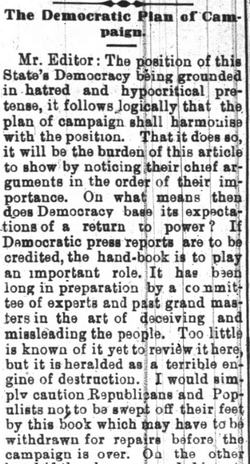
Source: Union Republican, Winston-Salem, NC (15 Sept 1898, 4).

This post is part of an ongoing series to understand the situation in 1895 when several hundred people, mostly African American men, guarded the Forsyth County Jail in Winston (now Winston-Salem), North Carolina, to protect a young African American man from lynching. My main goal is to understand the background and, to the extent possible, the motivation of the almost fifty men known by name to have participated in the action to protect Arthur Tuttle.
     In this part of the series, I am reviewing two anonymous letters published in the Winston Union Republican during the electoral campaign of 1898. Although these letters were written three years after the incident in question, they provide a contemporary view of the political situation, albeit from a white perspective. The writer is blind to the the failure of the Republicans to treat African Americans fairly, a failure that contributed to the 1898 electoral and moral debacle. To quote from a previous post (“An Introduction to the Background: Suicide Wrapped in an Illusion”; see below for the link), “To some extent, white Republicans were willing to grant a degree of political equality to blacks, but they resisted social equality, particularly in any setting that brought black men into relations with white women or placed blacks in authority over whites. Only a courageous genius could have navigated those stormy straits. But white Republicans—reluctant to appoint their African American allies to lucrative patronage positions or elect them to higher office—were not courageous or generous, and were all too were eager to find an excuse to abandon the backbone of the party.”
      Why then print the letters? The writer may be blind to the faults of his own side, but he is acutely aware of the manipulative and racist bloody-mindedness of his Democratic opponents. 

The posts that have brought us to this point are:

• "'Pluck Enough': The Story So Far”
• "'Pluck Enough': An Introduction to the Background: Suicide Wrapped in an Illusion" 
• "'Pluck Enough': A Note on Methodology”
• “The Ruffin Letter #1—A Survey of Political History in NC, 1865-1898”

     The second letter is longer than the first and reflects recent speeches and action by Democrats reported in the press. I have divided it into two parts. The purpose of the letter is to describe the “arguments” with which the Democrats will conduct the 1898 campaign. It labels as arguments the following means of persuasion and intimidation—the Democratic party handbook, cartoons (presumably editorial cartoons), the rally, demagogic speeches, and the threat of violence.
     In the second part of the letter, the writer will discuss the Democrats’ abuse of language and their use of a false analogy between the period of Reconstruction after the war and the period of Republican-Populist rule after the elections of 1894 and 1896.
     Throughout, the writer fails to acknowledge the weakness of the coalition (the Fusion) of Republicans and Populists opposing the Democrats. After their successful campaigns in 1894 and especially 1896, the coalition had achieved many of the legislative goals they agreed on, for example, capping interest rates, moving control of local government from the legislature to local voters, and reforming the election machinery to ensure an accurate count of the vote. But they disagreed on the way forward. All they offered in the 1898 election was opposition to the Democrats.
 
*****
 
Mr. Editor:
     The position of this State’s Democracy being grounded in hatred and hypocritical pretense, it follows logically that the plan of campaign shall harmonise [sic] with the position. That it does so, it will be the burden of this article to show by noticing their chief arguments in the order of their importance. On what means then does Democracy base its expectations of a return to power? If Democratic press reports are to be credited, the hand-book is to play an important role. It has been long in preparation by a committee of experts and past grand masters in the art of deceiving and missleading [sic] the people. Too little is known of it yet to review it here, but it is heralded as a terrible engine of destruction. I would simply caution Republicans and Populists not to be swept off their feet by this book which may have to be withdrawn for repairs before the campaign is over. On the other hand if they have succeeded in getting out a hand-book that will stand the vicissitudes of a heat [sic] campaign, let them have fun with it, as it would be cruelty to require them to make two campaigns without a hand-book to go by. This may be termed the hand-book argument.
     The next is the cartoon argument. The people have some experience with this argument, so they are somewhat prepared to estimate it at its true value. They once saw pictures of Vice-President Morton closing out this State under mortgage, but they remember that he was elected and the sale never really came off. The cartoon is not likely to cut much figure except as a boomerang.
     [para break inserted] The next, while not entirely new, presents some novelty in that it is intended to influence the judgment by way of the stomach, and may be denominated argument through the stomach. This is an old racket worked over and more formidable to meet. What then, is there is the much heralded politico-social pic-nic, the grand rally, with farfamed bands of music, the presence of the beauty and chivalry, barbecued meats, and Democratic oratory galore? Ostensibly, here is an altogether praise-worthy affair, a day off with much good things to eat, good fellowship, and just a little politics thrown in for variety and diversion. Give me your attention while I unmasque this humbug, for here, as in everything touched by Democracy, is hypocritical pretense and deception
     [para break inserted] The object of the grand rally is not for pleasure and entertainment, but to get votes, to accomplish by circumlocution what is unattainable in the open. The underlying purpose is to influence a class of voters for whom inwardly, the Democracy entertains the most hearty contempt, the common laborer, the presumption being that he will sell his vote for a mess of meat. Lured to the grounds by flaming hand-bills, after seeing the crowd and listening to the music, the physical appetite after awhile [sic] begins to assert itself. He sees the fat of the land which a liberal campaign fund has provided spread out before him, with the very first society in waiting, with most bewitching smiles, inviting him to eat, drink, and make himself welcome. If he yields, he compromises his self-respect, and from the stand-point of the campaign committee enters into a tacit agreement to deliver his vote in November. What! eat Democratic meat, and then vote against the party? Will a campaign committee invest three to five hundred dollars in a big spread merely in the interest of good fellowship? Is there anyone so unsophisticated as not see in a grand rally a very serious and shrewd form of business politics?
     It must be granted for this argument that it bears the stamp of antiquity, for away back in the dawn of history did not the wily Jacob put up a job on his brother Esau by which the latter forfeited his birthright? As to the origin of this argument, we get a further glimpse from the latter incident in which the Saviour, after the forty days fast, was approached by Satan with the proposition: “If thou be the Son of God, command that these stones be made bread.”
     Another point to this argument is its appeal to another weakness of human nature—the disposition to float with the current, to go with the multitude, irrespective of the merits of the question at issue. The grand rally to the voter without entitled convictions is expected to produce the impression, by the force of numbers, that there is only one side, the Democratic. For effect in other parts of the State the number actually present is exaggerated till the proverbial fish-liar has become a back number and not to be compared to the Democratic liar who counts the number present at a grand rally.
     [para break added] The Democracy having lost the election machinery of the State, and with it the power to count in its ticket, it is driven in this year of grace to rest its case wholly on its ability to deceive a majority of the voters, so this brings me next to consider the strongest card, at least, from the Democratic standpoint, the inflammatory shriek of the demagogue. He is to be much in evidence at the grand rally, and is expected to get in his work on a full stomach. Let it be understood that he has the unqualified endorsement of an unscrupulous State press, both the gold bug and free silver wings flapping together in substantial harmony. Masquerading in the uniform of a patriot, arrogating to himself the guardianship of the State’s honor, he assumes to represent the virtue and intelligence of the State, and to be engaged in waging an altogether unselfish warfare against official corruption and incompetency, and in the interest of good government and the peaceful reign of law and order, all unconscious that the means and methods to make good his claims are an insult to the intelligence and law abiding sentiment which he feigns to represent. The devil is never so dangerous as when he assumes the form of an angel of light.
     Let’s pull aside the lion’s skin that the ass’s ears may come into view. Let’s strip the cloak of virtue off hypocrisy. Vainglorious old Democratic humbug! Inglorious old fraud! Your cheek is colossal, your effrontery is mountain high. You have not had an issue since the war. You have only had a cry, a wail, a shriek—white man! n***r get you! Nor have you an issue now. Tariff reform? Free silver? Merely different forms of soothing balm for the consciences of those who shrink from more drastic measures. Listen to ex-American tourist to Europe, Bellamy on tariff reforms and free silver: “These are our tenets, but they are to some extent secondary in this campaign,” and half a minutes [sic] time is all he takes to enumerate these profound doctrines and his position thereon! [Bellamy was from a prominent family in Wilmington and a Democratic candidate for Congress. He was a key figure in the Red Shirt movement and the Wilmington coup, both intended to suppress the Black vote in anticipation of constitutional changes to disenfranchise African Americans and many poor whites. At this time he was crisscrossing the state giving inflammatory speeches.] I charge the State Democracy that just now, while it is posing as the self-appointed guardian of the State’s honor, and the gratuitous champion of “law and order” that through its campaign shriekers and State press, it is dragging the good name of the State in the mire, is by false accusation, casting suspicion on its credit, is by mean insinuation stabbing one of its most sacred institutions; and by incendiary appeal, is fomenting sedition, anarchy and bloodshed. The highwayman accosts the traveler with the alternative, your money or your life!

Email comments and questions to [email protected]

0 Comments

Happy New Year! With a Glimpse of My 2023 Reading

1/1/2024

1 Comment

 
Picture
One of my birthday presents this year was this collection of haiku, a multilingual volume beautifully bound (in the Chinese style) and illustrated. The translator is Hart Larrabee.
​*********

I’ve been impressed with several of the 2023 readings lists I’ve seen on Facebook, so I’ve come up with my own list. I’m a sloppy reader—sometimes reading just parts of books, rereading books in whole or part, unsystematically taking notes. I’d like to think my reading habits are like the bee described by Jonathan Swift, that “visit[s] all the Flowers and Blossoms of the Field and Garden, but whatever I collect from thence, enriches my self, without the least Injury to their Beauty, their Smell, or their Taste.”

Below are some of the books I visited this year, with quotations from some. In the spirit of Swift’s bee, they are presented as I think of them.

  • The Book of Mormon: The Earliest Text:
    “And when he had said these words, he wept;
    and the multitude bare record of it.
    And he took their little children, one by one, and blessed them
    and prayed unto the Father for them.
    And when he had done this, he wept again.
    And he spake unto the multitude and saith unto them:
    Behold your little ones.
    And as they looked to behold,
    they cast their eyes towards heaven;
    and they saw the heavens open,
    and they saw angels descending out of heaven
    as it were in the midst of fire.
    And they came down and encircled those little ones about
    —and they were encircled about with fire--
    and the angels did minister unto them.”—3 Nephi 17:21-24
  • Kate Holbrook, Both Things Are True: “For me, the most urgent and relevant questions about the truth of the Church have to do with our relationships to one another and to God. Do you find God in the Church? Does earnest Church participation bind you to others? Does the ritual and service you engage in at Church enlarge your soul?”
  • Simon Leys, The Hall of Uselessness: “Unamuno was a Catholic for whom the problem of faith remained all his life the central issue: not to believe was inconceivable—and to believe was impossible. This dramatic contradiction was well expressed in one of his poems:
    ‘ . . . I suffer at your expense, / Non-existing God, for if You were to exist, / Me too, I would truly exist.’”
  • Clive James, Cultural Amnesia: “When young and cocky, I had defined a poem as any piece of writing that could not be quoted from except out of context. Older but even more ambitious, I had the temerity to define prose in the same way: a prose work of whatever length should be dependent, in each part, on every other part of what was included, and so respect the importance even of what had been left out. From the force of cohesion would come the power of suggestion, and one of the things suggested should be the existence of other voices.”
  • Winston Churchill, The River War
  • Randolph Churchill and Martin Gilbert, the first four volumes of the eight-volume biography of Winston Churchill
  • Geoffrey Hill, Broken Hierarchies: Poems 1952-2012: “Even now one is amazed / by transience: how it outlasts us all” ("Scenes with Harlequins")
  • Andrew Skinner and Gaye Strathearn, Third Nephi: An Incomparable Scripture
  • Joan Barasovska, Orange Tulips. My review is forthcoming in the NC Literary Review (online) (along with a review of the next book by Janis Harrington). Here's part of a poem from Orange Tulips: 
    At night the trees lie down to rest.
    They unclench their roots, groan,
    and all sink down....
    At sunrise they rustle,
    yank themselves upright.
    Some leaves get lost.
    They twist to get the angle right
    and dig in for the day.
  • ​Janis Harrington, How to Cut a Woman in Half:
    Jeweled colors splash to the horizon:
    yellow fennel, poppies, verbena, blue lupine.
    Annie parks on the shoulder, opens the door,
    finds a path to the meadow. Shedding
    her jacket, she lifts her face to the sun.
    Let this temporary parole from distress
    remind her that beauty and joy still exist. 
    (“Prayer for My Sister,” 57)
  • N.T. Wright, Paul: A Biography
  • Joseph Bathanti, Light at the Seams, and Joseph Mills, Bodies in Motion. My review has been published by the NC Literary Review (online). Bathanti: “Each year, the centurial black walnut / threatens to expire, // yet flowers branch by branch, bud by bud, magisterial / in its hour” (“Daylily”).
  • Yosef Hayim Yerushalmi, Zakhor: Jewish History and Jewish Memory, esp. the intro. by Harold Bloom
  • Roberto Calasso, The Ruin of Kasch: “Tsar Peter III, who played games with wooden soldiers and had a mouse court-marshaled and hanged for daring to climb over two cardboard fortresses, decided to introduce in Russia the code of law that Frederick the Great had recently brought into force in Prussia. ‘But,’ as Claude Rulhière noted, ‘both through the ignorance of the translators and the shortage of words in the Russian language for all the ideas of law, not a single senator could understand the code; and the Russians saw this vain attempt merely as a sign of contempt for their own ways and a foolish attachment to foreign ways.’ When it came to the age that sought to explain history step by step, Frederick’s enlightened and military law was replaced by Marx’s law of the phases of development of productive forces. But both of these served above all to perfect the practices of the Bureau of Secret Affairs, set up by Peter the Great to oversee the conduct of the nation through a sophisticated policing system—and which continued operating with zeal and providence under various names, from Ochrana to the KGB, offering among other things the only example in Russia of the undeniable march of progress.”
  • Roger Scruton, Fools, Frauds and Firebrands
  • Roger Scruton, Philosopher on Dover Beach
  • Richard Lyman Bushman, Joseph Smith’s Gold Plates
  • Mattias Desmet, The Psychology of Totalitarianism
  • Iain McGilchrist, The Master and His Emissary: “Metaphoric thinking is fundamental to our understanding of the world, because it is the only way in which understanding can reach outside the system of signs to life itself. It is what links language to life.” “The point of metaphor is to bring together the whole of one thing with the whole of another, so that each is looked at in a different light. And it works both ways, as the coming together of one thing with another always must. You can’t pin one down so that it doesn’t move, while the other is drawn towards it: they must draw towards each other. As Max Black says: ‘If to call a man a wolf is to put him in a special light, we must not forget that the metaphor makes the wolf seem more human than he otherwise would.’”
  • Samuel Beckett, “Krapp’s Last Tape” [a play]
  • Mary Terrall, Catching Nature in the Act
  • Horace’s Odes, in translations by David Ferry and James Michie
  • W.G. Sebald, The Rings of Saturn: “If we stand today before the large canvas of Rembrandt’s The Anatomy Lesson in the Mauritshuis we are standing precisely where those who were present at the dissection in the Waaggebouw stood, and we believe that we see what they saw then: in the foreground, the greenish, prone body of Aris Kindt, his neck broken and his chest risen terribly in rigor mortis. And yet it is debatable whether anyone ever really saw that body, since the art of anatomy, then in its infancy, was not least a way of making the reprobate body invisible. It is somehow odd that Dr Tulp’s colleagues are not looking at Kindt’s body, that their gaze is directed just past it to focus on the open anatomical atlas in which the appalling physical facts are reduced to a diagram, a schematic plan of the human being, such as envisaged by the enthusiastic amateur anatomist René Descartes, who was also, so it is said, present that January morning in the Waaggebouw. In his philosophical investigations, which form one of the principal chapters of the history of subjection, Descartes teaches that one should disregard the flesh, which is beyond our comprehension, and attend to the machine within, to what can fully be understood, be made wholly useful for work, and, in the event of any fault, either repaired or discarded."
  • Kevin and Leah Klein, Showdown Symphony
  • Ethan Unklesbay, “Dust.” I published a brief appreciation on my blog.
  • Peter Brown, Journeys of the Mind: A Life in History
  • Nigel Steel and Peter Hart, Passchendaele: The Sacrificial Ground
  • John Keegan, The Face of Battle​: “Just as the Lisbon earthquake is said to have given a timely stimulus to religious observance in eighteenth-century Europe, it is often adumbrated that the battle of Stalingrad has been the most important single lesson in the education of a democratic Germany. How true is that? The repression of the Paris Commune in 1871 undoubtedly left scars on the psyche of working-class Paris which ache to this day. But what exactly did the battle of France in 1940 do to the psyche of the French nation? The very size of the question ought not to deter the historian from attempting an answer. A few have already had a bite at it. Alistair Horne had tried to demonstrate that the experience of Verdun in 1916 led the French, by way of the building of the Maginot line, to the construction of the fortress of Dien Bien Phu, and its fall to the collapse of their colonial empire. But a real examination requires ... a very special sort of historical expedition: not so much a plunge into the archives as a voyage through a nation’s literature, from Sartre’s La Mort dans l’Ame via the script of Les Jeux Interdits to the soundtrack of Le Chagrin et la Pitié.”
  • Charles Habonimana, Moi, Le Dernier Tutsi: "J'ai 12 ans et je vais mourir." Here's my rough translation of the first chapter:
    Calvary
         My name is Charles. I’m twelve years old and I’m going to die.
         Like those who preceded me to the top of the hill and who lie in a heap before my eyes, bodies mutilated, limbs scattered, heads decapitated. Bodies everywhere, and all around, the mob beside itself. Hundreds of faces I know, neighbors and former friends, who have come running to participate in the executions as if they were hurrying to a family party. They want to see. They must see. So they trample the corpses, climb the heaps of broken bodies.
         Many are ready to finish off the dying. The blood flows and they chant their victory to the insistent pounding of feet beating the earth in time. Like a warning signal, in the din I hear the rasping of the machetes as they scrape against rock and sharpen their blades. Something in the air impels, inebriates more than beer, clutches tighter than hate. Something awe-inspiring and insane.
         Before me, so close that I can almost touch, lies our dear Léonard Sebuyonde, who served as a priest in the village. Immobile, lying on his back, his arms crossed, crucified on the rock like Jesus on the cross. Slashed in so many places I can’t count his wounds.
         Over there are my buddies, who played football after school. In the middle, Toto, my dear cousin: his face, cleanly cut off with a machete, lies to the left of his head, which is no more than a gaping wound open to the sky. Farther away, Eustache Kayihura, the old wise man, the intellectual, so respected in the village, rigid in his Sunday suit, with his beautiful white beard soaked in blood. Throat cut.
         Lying against him is another elder, Daniel Mujyarugamba, survivor of the [mass] murders of 1973. His right arm was then severed by a machete blow and he has since worn a sort of rod in its place. This time, the machete struck him on the left and a club killed him. The force of the blow made his eyes start from their orbits. Below, a young married couple is dying; she is still in her white dress, shaken by spasms that make her swallow her tongue, he is still in his elegant suit begging for someone to finish them off. But no one comes. There is also the old Anastasia, bleeding in her ceremonial outfit; Évariste Birikunzira and her brother Vincent Nzitabakuze, struck down side-by-side; and all those whom I do not recognize—too much blood, too many corpses.
         I’m afraid. I look at Papa, seated next to me with his cousin Fidel Rwirangira.
         We have climbed together our familiar hill, since this morning rebaptized “the way of Calvary” by the killers themselves. Since then they’ve made their prey—women, men, children, old people—climb up. The hunt began at first light, around 5 o’clock, and has not stopped. As the day of their hellish work has gone on, the captured have formed a long moving column, like ants that stubbornly follow each other and that I’ve annoyed with a twig without ever making them leave their route.
         Then it was our turn to take the path. From his first steps, Fidel understood that this was his way of the cross. Official propaganda identified him to the crowd as the leader of the “cockroaches,” the leader of the “snakes.” Those who must be crushed like vermin. Then, all along the climb, two rows of villagers unleashed their blows on him. Everyone took turns taking a swing, with a club, with a stick or machete, and with a powerful leap each landed a blow on Fidel. His beautiful suit, his Sunday suit, gradually turned red, was torn to shreds, as blow followed blow. Each time he fell. Each time he rose alone; the torturers stopped us from helping him.
         Fidel has arrived at the summit a thousand times dead, but is still with us, still in his Passion. Until the last three club blows, the spurting blood, the cheers.
         He is no longer moving.
         I do not wish to die like him. Not by the club—I prefer the machete, like my buddy Toto. A blow, a single one, to end it all. I’m so afraid, Papa. But you can no longer hear me. The killers circle you. They chant, shout, whistle. They already rejoice in your death, here, under the eyes of your child. Papa, you who always seemed so strong, so courageous, are now powerless, resigned. Like an animal at the slaughterhouse waiting for the knife.
         They call out to the cook of my father’s cabaret, whom father threatened one evening during an argument. They push him to kill: “he wanted to kill you, so kill him!” The feet, the spears, the rhythm on the rock, the earth, the skin, the terror. Two men press him, encourage him. All three begin the work. They strike in rotation, blow after blow. The back, the head. At each impact, I cry out. Papa falls, the blood flows from his mouth, his nose, the ears, the eyes. I see the jolts [of his body]. It is the 24 of April 1994.
         I am twelve years old and I am going to die.
    by Charles Habonimana and Daniel Le Scornet, Moi, le dernier Tutsi (French Edition) (pp. 4-6). Place des éditeurs. Kindle Edition.
  • Hart Larrabee, trans., Haiku Illustrated
  • Dominic Hibberd and John Onions, The Winter of the World. An excellent anthology of British poetry from the First World War. I visit it often. 
Updated 2-3, 10 January 2024. 
Send comments, questions, critiques to [email protected]
1 Comment

    Author

    Write something about yourself. No need to be fancy, just an overview.

    Archives

    June 2025
    May 2025
    March 2025
    February 2025
    January 2025
    December 2024
    November 2024
    October 2024
    August 2024
    July 2024
    June 2024
    May 2024
    February 2024
    January 2024
    December 2023
    November 2023
    October 2023
    September 2023
    May 2023
    April 2023
    February 2023
    November 2022
    September 2022
    August 2022
    July 2022
    June 2022
    May 2022
    April 2022
    March 2022
    February 2022
    January 2022
    December 2021
    November 2021
    October 2021
    September 2021
    August 2021

    Categories

    All

    RSS Feed

Proudly powered by Weebly